it's really not noticeable in real content, not even in my perfect dark room. I'm watching the TV show Paradise right now, and it has tons of 3- 4 seconds full black screens. It doesn't stay black long enough for my eyes to adapt and see the faint glow so this is not a problem at all on this TV. My C2 blacks are raised more than that and I could see it all the time in real content.deadchip12 wrote: Sun May 04, 2025 12:56 pmThis sucksRESET_9999 wrote: Sat May 03, 2025 1:52 pm One more thing I noticed on the G5. The RGB white balance trick doesn't work to fix the DV raised black, not even at -6/-6-/6.
Dolby Vision now possible through MP4 Mux.
-
RESET_9999
- Posts: 2421
- Joined: Mon Aug 05, 2019 7:12 pm
Re: Dolby Vision now possible through MP4 Mux.
-
kazuma
- Posts: 186
- Joined: Fri Nov 08, 2019 9:51 pm
Re: Dolby Vision now possible through MP4 Mux.
you won't getting CE updates anymore once you installed cpm build if i'm correct? what if there is a new kodi version? do i need to install that manual and then install cpm build again?SamuriHL wrote: Sun May 04, 2025 11:23 amThere's not likely to be any new builds from what I understand. It's a very long story but it has to do with the underlying kernel and the fact that CE is moving to a newer one that won't support FEL on the ugoos. But in any case think of cpm like an extension. It includes all of the CE functionality then it's own on top of it.kazuma wrote: is cpm taking the newest stable versions of CE with every new cpm update?
Sent from my SM-S938U1 using Tapatalk
-
SamuriHL
- Posts: 2802
- Joined: Mon Jun 14, 2010 5:32 pm
Re: Dolby Vision now possible through MP4 Mux.
That's not how it works. CPM replaces CE so no you won't be getting any updates from CE once you install CPM. CPM builds are manually installed with update files. Kodi is not some "separate thing" you install. It's built into the image. So no, you won't be getting Kodi updates.kazuma wrote: Sun May 04, 2025 6:57 pm you won't getting CE updates anymore once you installed cpm build if i'm correct? what if there is a new kodi version? do i need to install that manual and then install cpm build again?
-
Trees
- Posts: 59
- Joined: Sat Sep 03, 2022 8:04 am
Re: Dolby Vision now possible through MP4 Mux.
I have a question for you RESET. The other day, someone said that every P5 DV file is supposed to have the following tag in MediaInfo:
Instead of:
Is this true? I've looked into it a little and I've noticed said tag is all over the place, pretty much every streaming service has both Limited and Full. What files should be Limited and what files should be Full? Should every 4K HDR file be Full or doesn't it matter? Sometimes it doesn't even show at all. What's the deal?
Code: Select all
Color Range : FullCode: Select all
Color Range : Limited-
RESET_9999
- Posts: 2421
- Joined: Mon Aug 05, 2019 7:12 pm
Re: Dolby Vision now possible through MP4 Mux.
yes, Profile 5 is supposed to be full range but Apple being Apple as always, all their stuff is in limited range. I don't think it matters though
-
daffie
- Posts: 76
- Joined: Sun Apr 16, 2023 6:10 pm
Re: Dolby Vision now possible through MP4 Mux.
But Dolby Vision from Apple is kinda crap anyways, right?RESET_9999 wrote: Mon May 05, 2025 1:27 pm yes, Profile 5 is supposed to be full range but Apple being Apple as always, all their stuff is in limited range. I don't think it matters though
LG OLED65G1RLA / Samsung HW-Q990D / Panasonic UB820 / Ugoos AM6B+ (CE with avdvplus Build)
-
RESET_9999
- Posts: 2421
- Joined: Mon Aug 05, 2019 7:12 pm
Re: Dolby Vision now possible through MP4 Mux.
Yep, and IMO everything Apple does is garbage (except their ProRes codec).daffie wrote: Mon May 05, 2025 2:26 pmBut Dolby Vision from Apple is kinda crap anyways, right?RESET_9999 wrote: Mon May 05, 2025 1:27 pm yes, Profile 5 is supposed to be full range but Apple being Apple as always, all their stuff is in limited range. I don't think it matters though
-
Trees
- Posts: 59
- Joined: Sat Sep 03, 2022 8:04 am
Re: Dolby Vision now possible through MP4 Mux.
Thank you.RESET_9999 wrote: Mon May 05, 2025 1:27 pm yes, Profile 5 is supposed to be full range but Apple being Apple as always, all their stuff is in limited range. I don't think it matters though
Interesting. Why do you think it doesn't make a difference? Someone asked AI:
What do you think?When opening a 4K HDR MKV file with MediInfo it has bunch of flags. One of them is Color range; sometimes 4K HDR files have the incorrect limited color range and the correct full range. What does this mean? What does this mean when playing it on a HDR TV? Will the colours display different per setting?
Let's break down color range in the context of your 4K HDR MKV files and what it means for playback on your HDR TV.
What does "Color range" mean?
In digital video, "color range" refers to the range of luminance (brightness) values that are used to represent the colors. There are two main types:
Limited Range (or TV Range): This range uses values from 16 to 235 for 8-bit video. This is the traditional range used for standard definition and high definition television broadcasts. The "black" level is at 16 and the "white" level is at 235.
Full Range (or PC Range): This range uses the full spectrum of values from 0 to 255 for 8-bit video. The "black" level is at 0 and the "white" level is at 255.
Think of it like this: Limited range is like using only a portion of a ruler to measure things, while full range uses the entire ruler.
Why is this relevant for 4K HDR files?
HDR (High Dynamic Range) is designed to display a much wider range of brightness levels than standard dynamic range (SDR). To properly utilize the capabilities of HDR, the video signal should ideally be encoded and transmitted using the **Full Range**. This allows for the deepest blacks and the brightest whites, contributing to the more realistic and impactful image that HDR aims to deliver.
What does it mean when a 4K HDR file has the incorrect "Limited" color range flag?
If a 4K HDR file is flagged as "Limited" range in MediaInfo, it means that the video data within the file is encoded using the limited range (16-235). This is technically incorrect for HDR content, which is designed to use the full range (0-255).
What does this mean when playing it on an HDR TV? Will the colours display different per setting?
Yes, this absolutely will affect how the colors and brightness are displayed on your HDR TV, and the difference can be quite noticeable. Here's why:
Misinterpretation by the TV: Your HDR TV expects HDR content to be in Full Range. When it receives a signal that is flagged as Limited Range but contains HDR data, it has to make an assumption about how to interpret the luminance values.
"Washed Out" or "Crushed" Image:
-If the TV interprets the Limited Range data as if it were Full Range, the image will likely appear washed out. The darkest parts of the image (intended to be 0 in Full Range) will be displayed at the TV's black level corresponding to 16, making blacks look grey. The brightest parts (intended to be 255) will be displayed at the TV's white level corresponding to 235, making whites look less bright and potentially clipping highlights.
- Less commonly, but still possible depending on the player and TV's processing, the image could appear crushed. This happens if the TV incorrectly maps the Limited Range values (16-235) to the full output range (0-255). This would make blacks too dark and highlights too bright, losing detail in both the shadows and highlights.
In summary:
Correct (Full Range) Flag: The video data uses the full range of luminance values (0-255 for 8-bit), allowing for the deepest blacks and brightest whites that HDR is capable of. When played on an HDR TV, the image should look as intended, with vibrant colors and excellent contrast.
Incorrect (Limited Range) Flag: The video data uses a restricted range of luminance values (16-235 for 8-bit). When played on an HDR TV, the image will likely appear washed out or potentially crushed, losing the full impact of the HDR presentation. The colors and overall picture quality will be compromised.
Will the colors display different per setting?
Yes, the setting of the color range flag within the MKV file directly influences how the video is interpreted by your playback software and ultimately your TV.
If the file is flagged correctly as "Full Range": Your playback software and TV should handle the HDR data as intended, resulting in the best possible picture quality.
If the file is flagged incorrectly as "Limited Range": Your playback software and TV might misinterpret the data, leading to the washed-out or crushed appearance described above.
What can you do about it?
Unfortunately, you cannot simply change the "Color range" flag in MediaInfo and expect the video to magically become Full Range. The flag is simply metadata describing how the video data was encoded.
Re-encoding (Complex): The most correct way to fix this is to re-encode the video using the full range. This is a complex process that requires video editing software and a good understanding of video encoding parameters. It's also time-consuming and can potentially degrade the video quality if not done correctly.
Player Settings (Limited Help): Some video players might have settings to force a specific color range output. However, this is often a workaround and may not perfectly correct the issue, as the underlying data is still encoded incorrectly. It's also not guaranteed to work on all players or TVs.
Source Quality: The best solution is to obtain a copy of the 4K HDR file that is encoded correctly with the Full Range flag. This indicates that the source material was likely handled properly during the encoding process.
In conclusion, the "Color range" flag in MediaInfo is a crucial indicator of how the luminance data in your 4K HDR file is encoded. An incorrect "Limited" range flag will negatively impact the picture quality when played on an HDR TV, making the image appear washed out or crushed compared to a correctly encoded "Full Range" file.** Always aim for 4K HDR files that are flagged as "Full Range" for the best viewing experience.
-
RESET_9999
- Posts: 2421
- Joined: Mon Aug 05, 2019 7:12 pm
Re: Dolby Vision now possible through MP4 Mux.
I dont know but I think I already tested this a long time ago when I was investigating the iTunes P5 colors shift.
The color range is just a flag and can be changed without re-encoding. You can try, Workflow 9-2 in my script.
The color range is just a flag and can be changed without re-encoding. You can try, Workflow 9-2 in my script.
-
skull88
- Posts: 69
- Joined: Mon Mar 27, 2023 3:08 pm
Re: Dolby Vision now possible through MP4 Mux.
Always be very cautious with AI responses, it is talking about 8-bit there, while HDR HEVC is 10-bit, and it may be answering that way depending on how you phrase the question to feed into your expectation bias. The Limited range flag is set on most files made when created using mkvtoolnix, makeMKV, and other applications that convert from retail sources like UHD Blu-ray discs (and also HD Blu-ray). In fact, I very, very rarely see Full range tag in MediaInfo, and if I do, it is for streaming encodes. Here is a better answer using both search and reasoning modes in ChatGPT 4o-mini. This matches my knowledge and testing on this historically too. If you want to learn more, this would be my pick for one article on the subject.
## Summary
The “Color range : Limited” flag in MediaInfo indicates the video’s coded value range is constrained to legal (TV) swing rather than full (PC) swing. For 10-bit video, limited range means luma (Y') code values span 64–940 and chroma (Cb/Cr) span 64–960. This applies equally to HDR10 and Dolby Vision on UHD Blu-ray sources and is the correct, expected encoding; it does not signify an error or quality issue.
## Color Range Defined
Limited (legal/TV) range reserves headroom and footroom for synchronization:
* **10-bit luma (Y')**: codes 64 to 940 ([Reddit][1], [Pomfort][2])
* **10-bit chroma (Cb/Cr)**: codes 64 to 960 ([Reddit][1], [Doom9 Forum][3])
Full (PC) range uses the entire code space:
* **10-bit luma**: 0 to 1023 ([Reddit][1], [The Post Process][4])
* **10-bit chroma**: 1 to 1023 ([Reddit][1], [Doom9 Forum][3])
## 10-Bit Code Values Compared to 8-Bit
* **8-bit limited**: Y 16–235, UV 16–240
* **10-bit limited**: Y 64–940, UV 64–960 ([bavc.github.io][5], [The Post Process][4])
* **8-bit full**: Y/UV 0–255
* **10-bit full**: Y 0–1023, UV 1–1023 ([Voukoder Pro][6], [Adobe Community][7])
## Applicability to HDR10 and Dolby Vision
UHD Blu-ray HDR10 and Dolby Vision streams adhere to Rec. 2100 specifications for narrow-range (limited) code values:
* Defined narrow-range 10-bit black level: 64; nominal peak white: 940 (Y) and 960 (Cb/Cr) ([Wikipedia][8])
* PQ transfer characteristics (ST 2084) and BT. 2020 primaries operate within these ranges ([Wikipedia][8])
Media players and displays map these limited-range code values to actual luminance, so end-user viewing is unaffected provided correct HDMI signaling (YCbCr 4:2:0 vs. RGB) and metadata pass-through.
## Conclusion
Limited range in a 10-bit HDR remux is standard for UHD Blu-ray HDR sources. It does not indicate a remux error or color clipping—leave the encoding unchanged.
[1]: https://www.reddit.com/r/ffmpeg/comment ... hatgpt.com "2 questions on \"limited\" vs. \"full\" color range : r/ffmpeg - Reddit"
[2]: https://pomfort.com/article/signal-rang ... hatgpt.com "Signal ranges, clipping, and 3D LUTs - Pomfort"
[3]: https://forum.doom9.org/showthread.php? ... hatgpt.com "SafeColorLimiter - Doom9's Forum"
[4]: https://www.thepostprocess.com/2019/09/ ... hatgpt.com "Full Levels and Video Levels Explained! - The Post Process"
[5]: https://bavc.github.io/qctools/filter_d ... hatgpt.com "Filter Descriptions | qctools - GitHub Pages"
[6]: https://www.voukoder.org/forum/thread/4 ... hatgpt.com "0-235 and 0-255 range switch for 10-bit ProRes still present? - Adobe"
[7]: https://community.adobe.com/t5/premiere ... hatgpt.com "Full range & Legal Range for video in adobe Premire question"
[8]: https://en.wikipedia.org/wiki/Rec._2100 ... hatgpt.com "Rec. 2100"
## Summary
The “Color range : Limited” flag in MediaInfo indicates the video’s coded value range is constrained to legal (TV) swing rather than full (PC) swing. For 10-bit video, limited range means luma (Y') code values span 64–940 and chroma (Cb/Cr) span 64–960. This applies equally to HDR10 and Dolby Vision on UHD Blu-ray sources and is the correct, expected encoding; it does not signify an error or quality issue.
## Color Range Defined
Limited (legal/TV) range reserves headroom and footroom for synchronization:
* **10-bit luma (Y')**: codes 64 to 940 ([Reddit][1], [Pomfort][2])
* **10-bit chroma (Cb/Cr)**: codes 64 to 960 ([Reddit][1], [Doom9 Forum][3])
Full (PC) range uses the entire code space:
* **10-bit luma**: 0 to 1023 ([Reddit][1], [The Post Process][4])
* **10-bit chroma**: 1 to 1023 ([Reddit][1], [Doom9 Forum][3])
## 10-Bit Code Values Compared to 8-Bit
* **8-bit limited**: Y 16–235, UV 16–240
* **10-bit limited**: Y 64–940, UV 64–960 ([bavc.github.io][5], [The Post Process][4])
* **8-bit full**: Y/UV 0–255
* **10-bit full**: Y 0–1023, UV 1–1023 ([Voukoder Pro][6], [Adobe Community][7])
## Applicability to HDR10 and Dolby Vision
UHD Blu-ray HDR10 and Dolby Vision streams adhere to Rec. 2100 specifications for narrow-range (limited) code values:
* Defined narrow-range 10-bit black level: 64; nominal peak white: 940 (Y) and 960 (Cb/Cr) ([Wikipedia][8])
* PQ transfer characteristics (ST 2084) and BT. 2020 primaries operate within these ranges ([Wikipedia][8])
Media players and displays map these limited-range code values to actual luminance, so end-user viewing is unaffected provided correct HDMI signaling (YCbCr 4:2:0 vs. RGB) and metadata pass-through.
## Conclusion
Limited range in a 10-bit HDR remux is standard for UHD Blu-ray HDR sources. It does not indicate a remux error or color clipping—leave the encoding unchanged.
[1]: https://www.reddit.com/r/ffmpeg/comment ... hatgpt.com "2 questions on \"limited\" vs. \"full\" color range : r/ffmpeg - Reddit"
[2]: https://pomfort.com/article/signal-rang ... hatgpt.com "Signal ranges, clipping, and 3D LUTs - Pomfort"
[3]: https://forum.doom9.org/showthread.php? ... hatgpt.com "SafeColorLimiter - Doom9's Forum"
[4]: https://www.thepostprocess.com/2019/09/ ... hatgpt.com "Full Levels and Video Levels Explained! - The Post Process"
[5]: https://bavc.github.io/qctools/filter_d ... hatgpt.com "Filter Descriptions | qctools - GitHub Pages"
[6]: https://www.voukoder.org/forum/thread/4 ... hatgpt.com "0-235 and 0-255 range switch for 10-bit ProRes still present? - Adobe"
[7]: https://community.adobe.com/t5/premiere ... hatgpt.com "Full range & Legal Range for video in adobe Premire question"
[8]: https://en.wikipedia.org/wiki/Rec._2100 ... hatgpt.com "Rec. 2100"
-
Trees
- Posts: 59
- Joined: Sat Sep 03, 2022 8:04 am
Re: Dolby Vision now possible through MP4 Mux.
That's alI need to know, to be honest, as the technical stuff goes way over my head.skull88 wrote: Tue May 06, 2025 12:09 am ## Summary
The “Color range : Limited” flag in MediaInfo indicates the video’s coded value range is constrained to legal (TV) swing rather than full (PC) swing. For 10-bit video, limited range means luma (Y') code values span 64–940 and chroma (Cb/Cr) span 64–960. This applies equally to HDR10 and Dolby Vision on UHD Blu-ray sources and is the correct, expected encoding; it does not signify an error or quality issue.
So for clarification purposes, I'm guessing you only need
Code: Select all
Color Range : Full-
staknhalo
- Posts: 178
- Joined: Sun Oct 11, 2020 12:05 am
Re: Dolby Vision now possible through MP4 Mux.
We know it won't be 'pixel perfect' - but something is better than nothing - Win 11 gonna be getting Dolby Vision switch with next update:
https://blogs.windows.com/windows-insid ... a-channel/
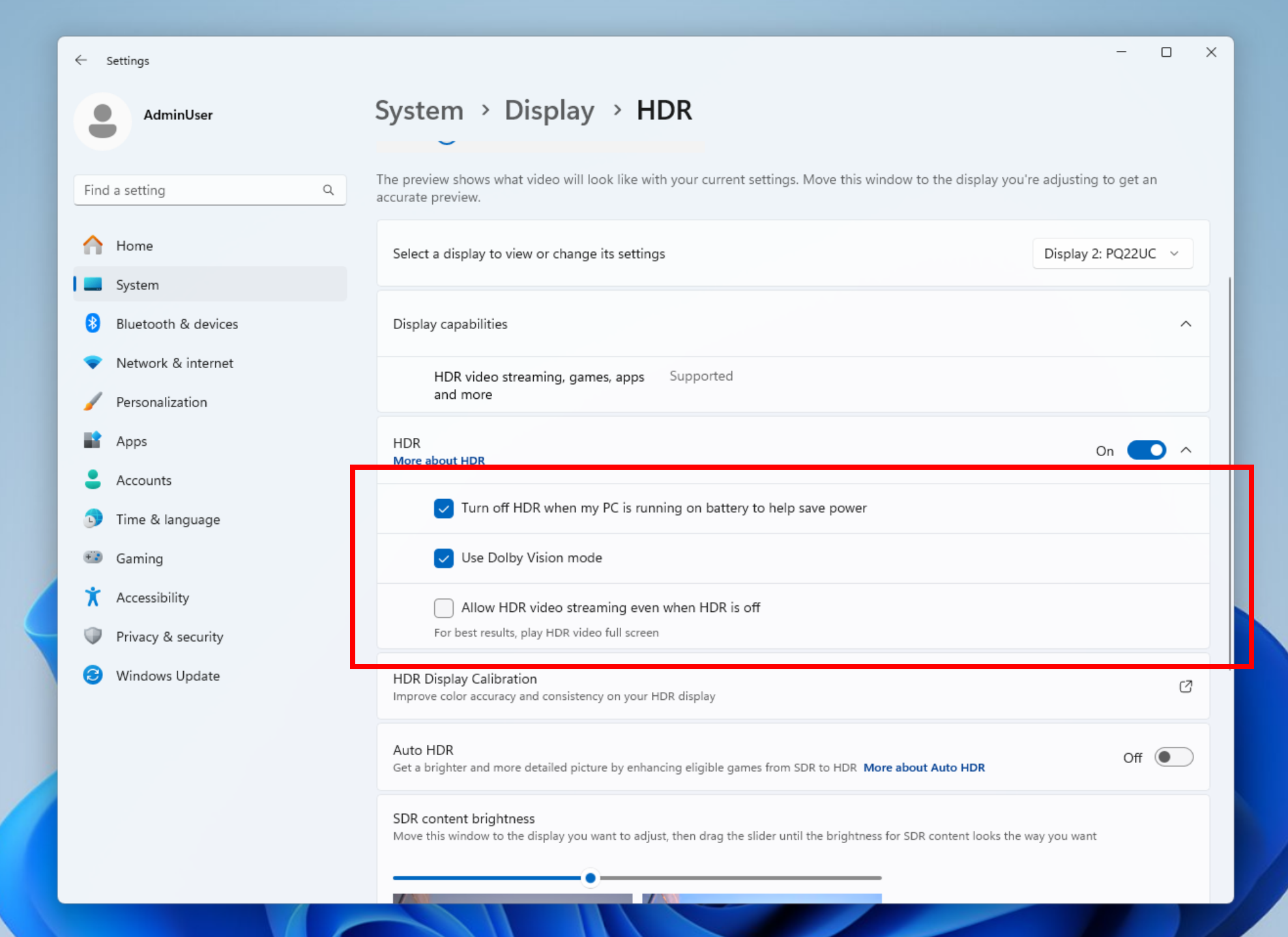
Edit: It's just a toggle for what we have now 'meant for DV displays' (even though you can view Windows DV content with the Microsoft Store DV plugin without a DV display)
https://blogs.windows.com/windows-insid ... a-channel/
Edit: It's just a toggle for what we have now 'meant for DV displays' (even though you can view Windows DV content with the Microsoft Store DV plugin without a DV display)
On PCs with HDR displays, we have added the option to allow HDR video streaming even when HDR is off in settings.
On PCs with Dolby Vision displays, we have added the option to toggle Dolby Vision mode independently from HDR. You can now enjoy HDR with Dolby Vision either on or off based on your preference.
-
RESET_9999
- Posts: 2421
- Joined: Mon Aug 05, 2019 7:12 pm
Re: Dolby Vision now possible through MP4 Mux.
yes, this should work natively with the 2025 LG OLED TVs but the older TV will require the EDID hack to allow it. And I wouldn't be surprised if it was just LLDV.

-
RESET_9999
- Posts: 2421
- Joined: Mon Aug 05, 2019 7:12 pm
Re: Dolby Vision now possible through MP4 Mux.
Nice, WEBOS-25 on the G5 supports natively DV MKV, but still suffers from the colorspace conversion and YCbCr clipping issues
https://slow.pics/c/IBNzcYOA
The older models might support it soon too, once they get updated to WEBos 25
https://slow.pics/c/IBNzcYOA
The older models might support it soon too, once they get updated to WEBos 25
-
LV8HD
- Posts: 53
- Joined: Tue Jan 11, 2022 3:48 pm
Re: Dolby Vision now possible through MP4 Mux.
Where can I find new versions (at least a source) of madMeasureHDR.exe? I've looked for it everywhere on the internet but I haven't been able to find it anywhere.