btw how do you like this demo on shield in comparison to x700?RESET_9999 wrote: ↑Tue Sep 29, 2020 4:36 pmthe file: https://drive.google.com/file/d/1ZRwhD- ... sp=sharing
Can you notice any odd thing?
Because I clearly see some problems
btw how do you like this demo on shield in comparison to x700?RESET_9999 wrote: ↑Tue Sep 29, 2020 4:36 pmthe file: https://drive.google.com/file/d/1ZRwhD- ... sp=sharing
yep, I see problems too. oversaturated.lexyz wrote: ↑Tue Sep 29, 2020 5:04 pmbtw how do you like this demo on shield in comparison to x700?RESET_9999 wrote: ↑Tue Sep 29, 2020 4:36 pmthe file: https://drive.google.com/file/d/1ZRwhD- ... sp=sharing
Can you notice any odd thing?
Because I clearly see some problems
Oversaturated, yes
Still can't get it to work even with other m2ts files (tried Black Panther and Justice League). I have Visual Studio 2019 installed and not 2010 though. Would that matter?Decidueye wrote: ↑Sun Sep 27, 2020 9:52 amHello everyone first post here complete newbie. I wanted to try if Dolby Vision playback with Mission Impossible movies is possible with my LG C9
First tried with Ghost Protocol. I followed the instructions on the first post and double checked, the new mp4 is successfully created but it doesn't work. The TV cannot read the file and says it is not supported.
Is there something I did incorrectly or is it because of the file or my TV?
Should be no difference in what you use to demux (ffmpeg, tsmuxer, eac3to). Although, ffmpeg and eac3to will tell you if there are any imperfections in the original files. It's rare, but if one is encountered, the files will still demux but you might encounter av sync issues upon remuxing.
BL being SDR shouldn't change anything, but this is actually what a properly specced profile 4 video should be (without an HDR BL).RESET_9999 wrote: ↑Tue Sep 29, 2020 6:10 pmthat demo file is FEL though. So they might just say that it's not supposed to be supported in the first place.
Also, the BL is SDR. not sure if that change anything
Please, why is it throwing me such a bug in DEMUX.iamTa wrote: ↑Mon Sep 28, 2020 11:49 amSo these are the steps I take to convert FEL to MEL and remux with TrueHD/Atmos into an MKV:
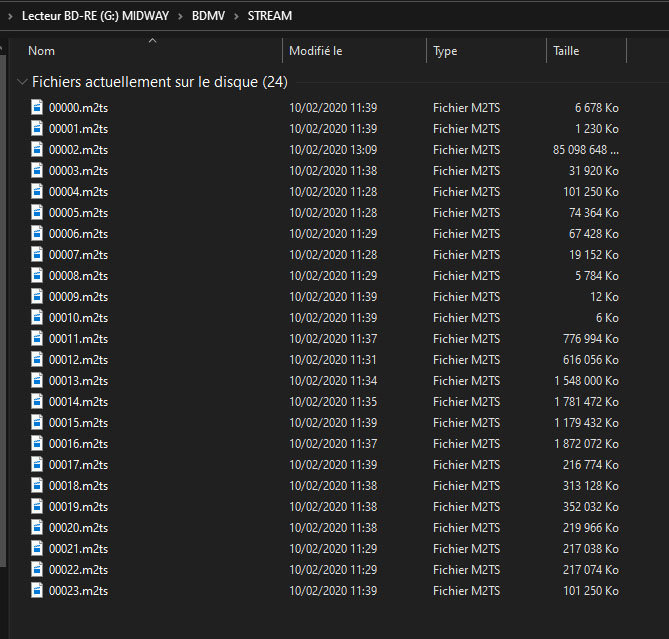
- Extract hevc streams with ffmpeg: ffmpeg.exe -i X:\BDMV\STREAM\XXXXX.m2ts -map 0:0 -c copy X:\BL.hevc -map 0:1 -c copy X:\EL.hevc
- Feed both hevc files from step 1 into MUX_AND_CONVERT_TO_MEL.bat
- Feed single hevc file from step 2 into DEMUX.bat
- Use latest tsMuxeR nightly, add both hevc files from step 3 into input along with X:\BDMV\STREAM\XXXXX.m2ts from step 1, remove duplicate video tracks and output to ISO
These MKVs can then be played back using the modded ExoPlayer and potentially the latest Emby beta (I've not tested Emby).
- Use MakeMKV to convert ISO to MKV
I've converted and tested a few full length movies and the above method works flawlessly.
Thank you yusesope for all your hard work.
Got it to work. I used the mp4muxer linked on page 200-201 with the 64 bit one. Everything worked from there.Decidueye wrote: ↑Tue Sep 29, 2020 6:10 pmStill can't get it to work even with other m2ts files (tried Black Panther and Justice League). I have Visual Studio 2019 installed and not 2010 though. Would that matter?
First input file is the bigger file, second one is the DV layer, third one is ac3 audio. The rest I copied from OP. Doesn't work. Any suggestions on what I most likely might have missed?
Links expired. Any new links for this? Will be trying this method now that I got the first step working!
Please check "tulip field" sceneRESET_9999 wrote: ↑Tue Sep 29, 2020 11:42 pmI'm not capturing any difference between FEL and MEL on the Shield suggesting it's ''maybe'' treating all the DV files as MEL.
Spears and Munsil: https://screenshotcomparison.com/comparison/6721
Hello yusesope.yusesope wrote: ↑Sat Sep 26, 2020 8:21 am
x265 does not need a parser for RPU. It simply accepts a file containing the RPUs (I presume sorted according to each access unit present in the Base Layer). Look HERE.ghostshadow wrote: ↑Thu Sep 24, 2020 5:39 pmGood evening yusesope, how do you get the RPU out of the EL? it is to be able to encode afterwards in x265
thank you
What's the problem? If you proceed with an encoding of the Base Layer then you must also change the parameters of the RPU. At the moment, however, we do not know the algorithm that allows to generate new RPUs!
Code: Select all
Général
ID : 0 (0x0)
Nom complet : MIDWAY\FullDisc\MIDWAY\BDMV\STREAM\00002.m2ts
Format : BDAV
Format/Info : Blu-ray Video
Taille du fichier : 81,2 Gio
Durée : 2 h 18 min
Type de débit global : Variable
Débit global moyen : 84,0 Mb/s
Débit global maximum : 109 Mb/s
Vidéo #1
ID : 4113 (0x1011)
ID de menu : 1 (0x1)
Format : HEVC
Format/Info : High Efficiency Video Coding
Profil du format : Main 10@L5.1@High
HDR format : SMPTE ST 2086, HDR10 compatible
Identifiant du codec : 36
Durée : 2 h 18 min
Largeur : 3 840 pixels
Hauteur : 2 160 pixels
Format à l'écran : 16/9
Images par seconde : 23,976 (24000/1001) Im/s
Espace de couleurs : YUV
Sous-échantillonnage de la chrominance : 4:2:0 (Type 2)
Profondeur des couleurs : 10 bits
Gamme de couleurs : Limited
Coordonnées de chromaticité : BT.2020
Caractéristiques du transfert : PQ
Coefficients de la matrice : BT.2020 non-constant
Mastering display color primaries : Display P3
Mastering display luminance : min: 0.0001 cd/m2, max: 1000 cd/m2
Maximum Content Light Level : 570 cd/m2
Maximum Frame-Average Light Level : 1504 cd/m2
Vidéo #2
ID : 4117 (0x1015)
ID de menu : 1 (0x1)
Format : HEVC
Format/Info : High Efficiency Video Coding
Profil du format : Main 10@L5.1@High
HDR format : SMPTE ST 2086, HDR10 compatible
Identifiant du codec : 36
Durée : 2 h 18 min
Largeur : 1 920 pixels
Hauteur : 1 080 pixels
Format à l'écran : 16/9
Images par seconde : 23,976 (24000/1001) Im/s
Espace de couleurs : YUV
Sous-échantillonnage de la chrominance : 4:2:0 (Type 2)
Profondeur des couleurs : 10 bits
Gamme de couleurs : Limited
Coordonnées de chromaticité : BT.2020
Caractéristiques du transfert : PQ
Coefficients de la matrice : BT.2020 non-constant
Mastering display color primaries : Display P3
Mastering display luminance : min: 0.0001 cd/m2, max: 1000 cd/m2
Audio #1
ID : 4352 (0x1100)
ID de menu : 1 (0x1)
Format : DTS XLL
Format/Info : Digital Theater Systems
Nom commercial : DTS-HD Master Audio
Type de muxing : Stream extension
Identifiant du codec : 134
Durée : 2 h 18 min
Type de débit : Variable
Canaux : 8 canaux
Channel layout : C L R LFE Lb Rb Lss Rss
Echantillonnage : 48,0 kHz
Images par seconde : 93,750 Im/s (512 SPF)
Profondeur des couleurs : 24 bits
Mode de compression : Sans perte
Délai par rapport Vidéo : 6s 6 ms
Audio #2
ID : 4353 (0x1101)
ID de menu : 1 (0x1)
Format : DTS XLL
Format/Info : Digital Theater Systems
Nom commercial : DTS-HD Master Audio
Type de muxing : Stream extension
Identifiant du codec : 134
Durée : 2 h 18 min
Type de débit : Variable
Canaux : 8 canaux
Channel layout : C L R LFE Lb Rb Lss Rss
Echantillonnage : 48,0 kHz
Images par seconde : 93,750 Im/s (512 SPF)
Profondeur des couleurs : 24 bits
Mode de compression : Sans perte
Délai par rapport Vidéo : 6s 6 ms
Audio #3
ID : 4354 (0x1102)
ID de menu : 1 (0x1)
Format : DTS
Format/Info : Digital Theater Systems
Identifiant du codec : 130
Durée : 2 h 18 min
Type de débit : Constant
Débit : 768 kb/s
Canaux : 2 canaux
Channel layout : Lt Rt
Echantillonnage : 48,0 kHz
Images par seconde : 93,750 Im/s (512 SPF)
Profondeur des couleurs : 16 bits
Mode de compression : Avec perte
Délai par rapport Vidéo : 6s 6 ms
Taille du flux : 759 Mio (1%)
Audio #4
ID : 4355 (0x1103)
ID de menu : 1 (0x1)
Format : DTS
Format/Info : Digital Theater Systems
Identifiant du codec : 130
Durée : 2 h 18 min
Type de débit : Constant
Débit : 255 kb/s
Canaux : 2 canaux
Channel layout : Lt Rt
Echantillonnage : 48,0 kHz
Images par seconde : 93,750 Im/s (512 SPF)
Profondeur des couleurs : 16 bits
Mode de compression : Avec perte
Délai par rapport Vidéo : 6s 6 ms
Taille du flux : 252 Mio (0%)
Texte #1
ID : 4768 (0x12A0)
ID de menu : 1 (0x1)
Format : PGS
Identifiant du codec : 144
Texte #2
ID : 4769 (0x12A1)
ID de menu : 1 (0x1)
Format : PGS
Identifiant du codec : 144
Texte #3
ID : 4770 (0x12A2)
ID de menu : 1 (0x1)
Format : PGS
Identifiant du codec : 144
Délai par rapport Vidéo : 8s 133 ms

You can choose the program you prefer. The beauty of the command line is that, in addition to providing you great flexibility, it allows you to concatenate the various programs (in windows just use "&&", Google is your friend if you want to learn more) without waiting for the first one to finish and then start the second, etc., etc.
Code: Select all
ffmpeg && mytool && tsmuxerPlease, list the steps you took before getting to use "DEMUX.bat"Tomas wrote: ↑Tue Sep 29, 2020 8:07 pmPlease, why is it throwing me such a bug in DEMUX.
It stops at the beginning. Thank you very much.
https://ibb.co/FqPw2jw
I've already solved that problem: you don't need those libraries anymore.
I'm on my cell phone at the moment and I honestly don't see any difference between the files tested on the Shield and those tested on the X700 (I'm referring to London Has Fallen).RESET_9999 wrote: ↑Tue Sep 29, 2020 11:42 pmno problem on the x700 for the single track FEL or MEL profile 4
.........................
I'm not capturing any difference between FEL and MEL on the Shield suggesting it's ''maybe'' treating all the DV files as MEL.
All seems right (in TsMuxeR you have to load BL.x265.hevc and not BL.hevc).
Please, list the steps you took before getting to use "DEMUX.bat"Tomas wrote: ↑Tue Sep 29, 2020 8:07 pmPlease, why is it throwing me such a bug in DEMUX.
It stops at the beginning. Thank you very much.
https://ibb.co/FqPw2jw
ok I understand, well I think.yusesope wrote: ↑Wed Sep 30, 2020 8:48 am
All seems right (in TsMuxeR you have to load BL.x265.hevc and not BL.hevc).
However, I repeat that the encoding of the Base Layer (BL) involves a complete reorganization of its internal structure.
The RPUs present in EL are no longer good.
From my point of view, the procedure is completely wrong!
Feel free to experiment...
Code: Select all
Extract the base layer and the enhancement layer
Code: Select all
ffmpeg -i path\to\the\file.m2ts -map 0:0 -c copy path\to\BL.hevc
ffmpeg -i path\to\the\file.m2ts -map 0:1 -c copy path\to\EL.hevc
Using my tool, double click on the MUX_AND_CONVERT_TO_MEL.bat file and follow the instructions on the screen.
You will get a BL_EL_RPU.hevc file